
How To Get Paid On Instagram Reels The Algorithmic Monetization Blueprint

Here is an uncomfortable reality that most social media gurus refuse to admit. Virality does not equal liquidity. You can post a funny reaction clip that racks up ten million views, and at the end of the month, Meta will deposit twelve dollars into your bank account. Meanwhile, a creator with five thousand followers posting dense, technical breakdowns of cloud computing architecture can quietly pull ten thousand dollars a month from three short videos.
If you are trying to understand how to get paid on Instagram Reels, you have to abandon the idea that raw view count is your primary currency. The modern creator economy is governed by algorithmic liquidity. Meta's neural networks do not distribute cash simply because people watched your video. Payouts happen when your content creates an ideal environment for high-bidding advertiser auctions or when you engineer a conversion pipeline that moves viewers off the platform.
Raw views pay pennies. Real Reels revenue is unlocked by triggering high-CPM semantic keywords in your audio, pacing video structure for mid-roll ad placement, and capturing warm buyers through automated direct message funnels.
The Fallacy Of The Viral Paycheck
The biggest trap aspiring creators fall into is chasing broad entertainment traffic. When you publish generic memes, funny pet clips, or dance trends, Meta's recommendation engine indexes your content in low-intent consumer clusters. These viewers are not looking to buy products, subscribe to software, or hire services.
Because the audience has low commercial value, the platform's ad-server fills the inventory around your video with the cheapest possible programmatic ads, such as mobile games and mass-market retail discounts. Your resulting Revenue Per Mille (RPM) drops to pennies. According to a Goldman Sachs Creator Economy Research report, creator monetization is rapidly shifting away from pooled platform payouts toward specialized, direct monetizable funnels.
Many creators still mourn the death of the early Reels Play Bonus program, where Meta paid lump sums of cash just for racking up impressions. Those programs were temporary loss-leaders designed to train creators to produce vertical video instead of posting on TikTok. Now that the short-form ecosystem is mature, Meta expects content to pay for itself through direct advertiser yield.
Advertisers and platform monetization engines do not evaluate follower counts when assigning real revenue value. They evaluate dwell probability and buyer demographics. A creator with ten thousand targeted followers who commands high attention duration is infinitely more valuable than an account with one million disconnected followers.
Decoding The Ads On Reels Payout Algorithm
If you want to earn meaningful income from Meta's native revenue sharing programs, you must engineer your videos for semantic valuation. Meta processes your video through Natural Language Processing and Computer Vision models the second it is ingested into the system.
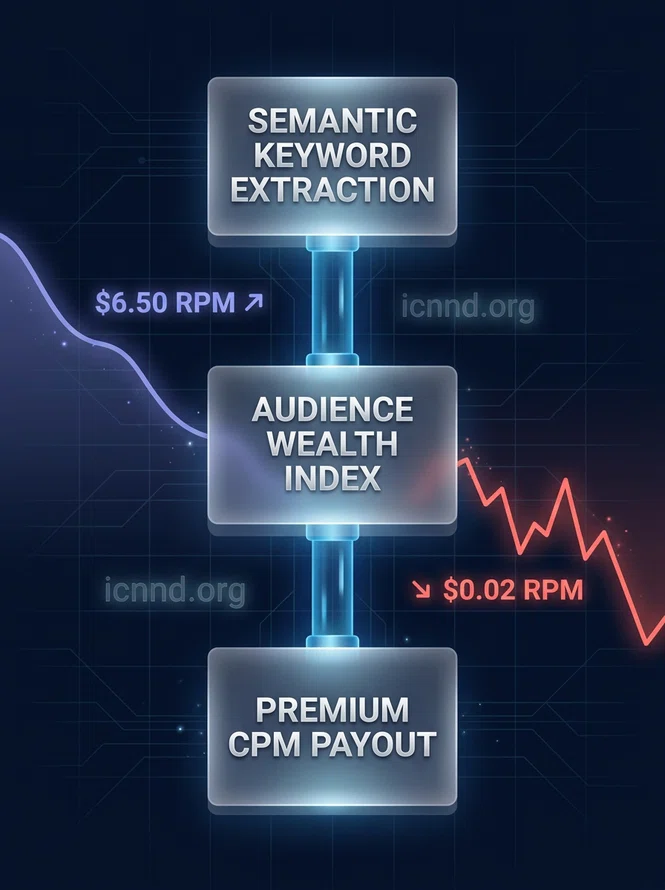
The audio transcript of your Reel is transcribed in real-time. When you verbally state high-value industry terms like enterprise software optimization or portfolio asset allocation, the system assigns a commercial tag to the post asset. High-bidding corporate brands are constantly competing to display their overlay and post-loop ads over content tagged with those precise commercial topics.
In contrast, if your video only features a trending audio track and silent hand gestures, the system cannot parse commercial intent. It defaults to baseline inventory, crushing your revenue potential before the first impression is served.
Pro Tip: Always record a clean vocal voiceover explicitly stating your niche keywords within the first four seconds. This guarantees that speech-to-text parsers index your Reel in high-paying commercial categories.
Another structural element that dictates your payout is mid-roll injection viability. The algorithm scans your video timeline to predict where a user is most likely to drop off. If you structure a pattern interrupt—a sudden visual change, a text pop-up, or an audio shift—exactly 1.5 seconds before a historical drop-off point, you force the viewer to stay. By artificially extending the session length, you secure the necessary viewability metrics for an ad slot to trigger, directly increasing your monetization yield.
Engineering High Conversion Funnels Through Direct Messages
Relying solely on Meta's internal ad revenue is financially irresponsible. The most lucrative strategy in 2026 involves taking the audience off the public feed and moving them into a private, controlled conversion environment. This is achieved through automated direct message architecture.
You have likely seen creators telling their audience to "comment a specific word" to receive a link. This tactic is not just about convenience; it is a calculated manipulation of the platform's engagement sensors. Requesting a keyword artificially inflates comment velocity within the first hour of publication. This rapid influx signals high algorithmic relevance, forcing the recommendation engine to push the Reel to a broader audience tier.
It is crucial to understand that the sheer value of comments dictates your foundational algorithmic baseline. When users take time to actively type and submit text, that friction acts as a heavy positive weight in the ranking matrix. Generating authentic discussions is vital for long-term account health, which is why utilizing professional community building tools from ICNND can establish the initial social proof needed to invite broader organic participation.

However, running mass automation carries severe risks. If you use software like ManyChat and program it to send the exact same reply to five hundred different users in ten minutes, Meta's spam filters will quietly shadowban your account. Your automation workflow must utilize randomized variable responses. Program five different variations of your automated reply to rotate sequentially, tricking the spam filter into classifying the behavior as organic human typing.
The Micro Sponsorship Arbitrage Model
You do not need fifty thousand followers to secure direct brand deals. You simply need to stop selling vanity metrics and start selling targeted distribution. The arbitrage model involves pitching high-ticket B2B companies or specialized software tools for $500 to $1,000 per video, even if your account only has a few thousand subscribers.
The pitch relies entirely on your Engagement Rate by Reach. If you can prove that your videos consistently penetrate a highly specific professional demographic—such as freelance graphic designers or real estate agents—your small audience becomes extremely valuable. Media buyers know that audience retention statistics differ wildly across platforms, and a hyper-targeted Instagram audience converts much higher than a massive, fragmented TikTok following.
- ✔ Reject Generic Shoutouts: Never accept a script that forces you to awkwardly pause and tell viewers to check the link in your bio. The algorithm recognizes forced promotional language and suppresses reach.
- ✔ Mandate Narrative Integration: Build the brand's product natively into a tutorial or a workflow breakdown, presenting it as the solution to a specific industry problem.
Field Notes My Journey Monetizing A Stagnant Account
Data theory requires real-world application. Last year, I assumed control of a stagnant 14,000-follower account in the digital design space. The previous owner posted generic design inspiration graphics. The account generated zero revenue and suffered from terrible algorithmic decay because the audience was entirely passive.
I executed a severe strategic pivot. I archived the generic content and transitioned exclusively to producing short, highly technical Reels showcasing hidden software tools for agency owners. The immediate result was terrifying. Overall account reach plummeted by forty percent because the legacy followers were not interested in software engineering.
However, the financial outcome was spectacular. By combining semantic keyword scripting with an aggressive DM automation funnel tied to high-paying affiliate software programs, the account generated $4,200 in pure profit within thirty days. We traded massive, useless vanity metrics for concentrated algorithmic liquidity. The machine learning model recalibrated our vector, pushing our content directly to purchasing decision-makers rather than casual scrollers.
Industry Voices What Top Strategists Say About Reel Monetization
If you want to understand the flow of capital on the platform, you have to talk to the people writing the checks. I frequently consult with media buyers at top-tier digital ad agencies, and their evaluation metrics have completely detached from public-facing vanity numbers.
The modern media buyer uses scraping software to analyze accounts for a high Save-to-Reach ratio. They literally ignore follower counts when distributing six-figure sponsorship budgets. If your video reaches ten thousand people and five hundred of them save it, you have proven deep audience utility. Brands will pay a massive premium to inject their product into a feed that commands that level of behavioral intent, which heavily skews the data we recently published in our average influencer rates analysis.
On the backend, former platform architects confirm that Meta's payout distribution heavily favors original, camera-facing content. Aggregated meme pages or accounts relying entirely on hyper-edited stock footage are quietly throttled in the monetization pool. The algorithm is trained to detect human faces and original environmental mapping, allocating higher ad-revenue shares to genuine creators rather than content recyclers.
Bypassing The Shadow Restrictions On Commercial Audio
Here is the most common reason creators fail to get paid despite generating millions of views. It is called the Content ID trap. When you switch your profile to a Business or Creator account to access monetization tools, you become legally bound by commercial copyright restrictions.
If you use a trending copyrighted song in your Reel, Meta will often let the video publish. It might even go viral. But behind the scenes, the system quietly disqualifies that specific video from the Ads on Reels revenue pool. You cannot monetize a video that features unlicensed intellectual property. A Meta policy update regarding music rights confirms that advertising revenue cannot be generated on assets utilizing protected audio tracks without specific commercial clearance.
To bypass this restriction without losing algorithmic momentum, you must manipulate your audio strategy. Rely on royalty-free soundscapes or explicitly clear commercial audio libraries. If you must use a trending sound, layer a dominant original voiceover on top of it while dropping the trending track's volume to two percent. This satisfies the algorithm's audio grouping mechanism for initial reach while maintaining your primary audio vector as original, monetizable content.
The Next Evolution Of Creator Capital
The era of the traditional influencer is ending. Waiting for a social media platform to hand you a monthly bonus check is a fragile business model. The creators who will thrive in 2026 and beyond are those who transition into media entities, completely controlling their own conversion pipelines from the first algorithmic impression to the final direct message sale.
Frequently Asked Questions
Advanced insights on Meta's internal monetization parameters.
Why are my Reels getting views but no ad revenue? +
Does automating Direct Messages lead to shadowbans? +
How many followers do I need to secure sponsorships? +

Written by Elena
View Full Profile →Senior Social Media Strategist & Algorithm Analyst
Watching talented creators generate millions of views while earning absolutely nothing inspired this guide. I wanted to expose the technical realities of semantic RPM algorithms so creators can stop chasing empty validation and start building real, liquid digital assets.