
The Evolution of the Feed: From Chronological to Machine Learning (2010–2026)
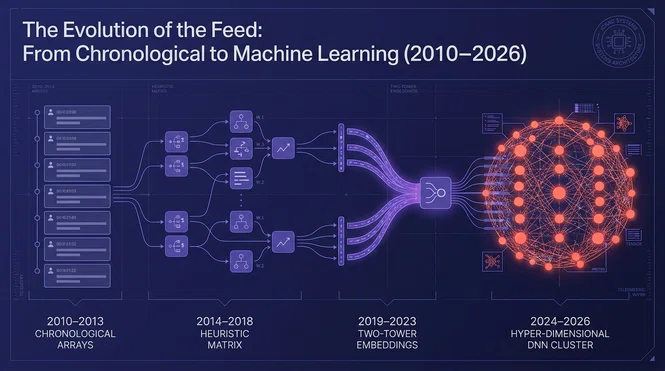
The transition of social feeds from naive linear sequences to high-dimensional inference engines represents one of the most consequential chapters in modern computer science. What originated in October 2010 as a simple database query ordering records by a Unix timestamp has evolved into a real-time computational pipeline capable of processing billions of candidate vectors per second. Understanding this sixteen-year progression is essential for academics, machine learning practitioners, and growth architects seeking to decode modern algorithmic discovery.
Instagram's feed moved from static, chronological database lookups (2010–2016) to weighted heuristic affinity scoring (2016–2019), and ultimately to high-dimensional Two-Tower vector embeddings and transformers (2020–2026). Feed ranking is no longer determined by who you follow or when you post, but by mathematical dot-product similarity between 512-dimensional multimodal content vectors and predictive user intent clusters.
The Era of Pure Chronology and Linear Distribution Systems
During the foundational era of social networking, distribution was direct, unmediated, and structurally deterministic. If an account published a post at 14:00:00 UTC, every user following that account received the media asset at the apex of their feed at 14:00:01 UTC. Content sorting operated strictly through the primary key of the media entity, producing an egalitarian yet unsustainable consumption model.
The Counter-Intuitive Reality of Chronological Feeds
Popular digital nostalgia often frames the chronological feed as the pinnacle of fair platform design. However, historical internal platform telemetry revealed a catastrophic UX failure mode: by early 2016, users routinely missed upwards of 70% of all posts published by their followed network. More critically, over 50% of the content generated by their closest real-world relationships was buried beneath an avalanche of commercial broadcasts and high-frequency publishing arbitrage.
Under chronological constraints, reach was not a function of artistic relevance, educational density, or narrative resonance. It was an operational exploit: accounts that posted 15 to 20 times daily captured an asymmetric share of user attention purely by colonizing the temporal access points of the app. This mechanical flaw degraded ecosystem retention and heavily disincentivized long-form or high-production creative output.
Database Architecture Constraints
From an infrastructure standpoint, the 2010–2014 Instagram platform ran on a comparatively lean technical stack. The feed assembly pipeline relied on Sharded PostgreSQL databases paired with aggressive Redis in-memory caching layers. The retrieval mechanism was essentially an indexed SQL query structured around an array of target user identifiers:
WHERE author_id IN (SELECT following_id FROM user_graph WHERE user_id = :current_user)
ORDER BY created_at DESC LIMIT 50;
While this architecture delivered sub-10ms query execution times and horizontal scaling across sharded clusters, it was functionally blind to the contents of the payload. The system possessed zero intrinsic awareness of image semantics, caption semantics, or past user preference patterns.
The Saturation Inflection Point
By late 2015, the network reached a hard mathematical threshold. The volume of daily active creators scaled into hundreds of millions, while the average human user's daily session length remained fundamentally bounded between 25 and 45 minutes. The total volume of published candidate inventory outstripped the available client-side viewport real estate by a factor of 40:1.
Linear consumption became mathematically unviable. The platform faced an existential inflection point: implement programmatic, predictive filtering, or witness platform collapse under the weight of uncurated temporal spam.
The Transition to Heuristic Ranking and Affinity Optimization
In March 2016, Meta (then Facebook Inc.) officially announced the deprecation of the strict chronological feed, completing the global rollout of algorithmic ranking by July 2016. This shift represented the second structural epoch: deterministic heuristic scoring engines.
The Heuristic Signal Triad
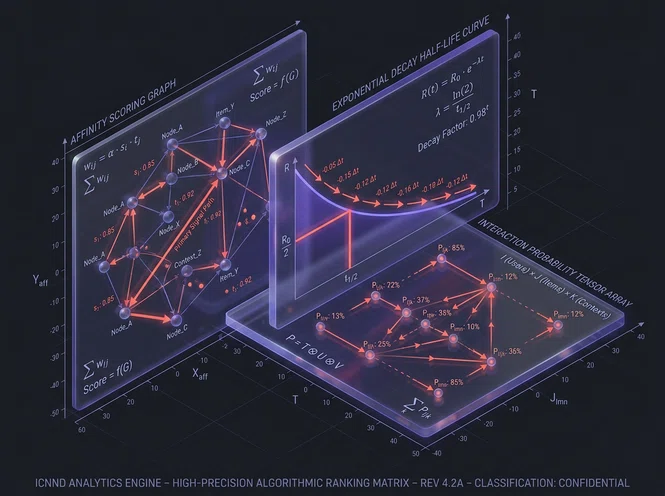
Early non-chronological sorting did not rely on deep neural networks. Instead, it deployed composite mathematical scoring formulas derived from three primary variables:
The Downranking of Pure Frequency
This heuristic scoring model immediately disrupted high-frequency publisher networks. The engineering team deployed session deduplication buffers and author frequency caps. If an account published six posts in thirty minutes, the heuristic engine assigned a compounding suppression penalty to the third through sixth posts within a single user’s viewport session, neutralising spam arbitrage overnight.
The Transition from Recency to Engagement Loops
Between 2017 and 2019, the weight of binary explicit likes steadily eroded. Platform telemetry demonstrated that likes possessed the lowest correlation with long-term retention. Engineering priority migrated toward implicit feedback signals: dwell time (viewport millisecond stabilization), full caption expansion clicks, and carousel scroll-depth metrics.
Reverse Engineering the Vector Embeddings Behind Feed Recommendation Systems
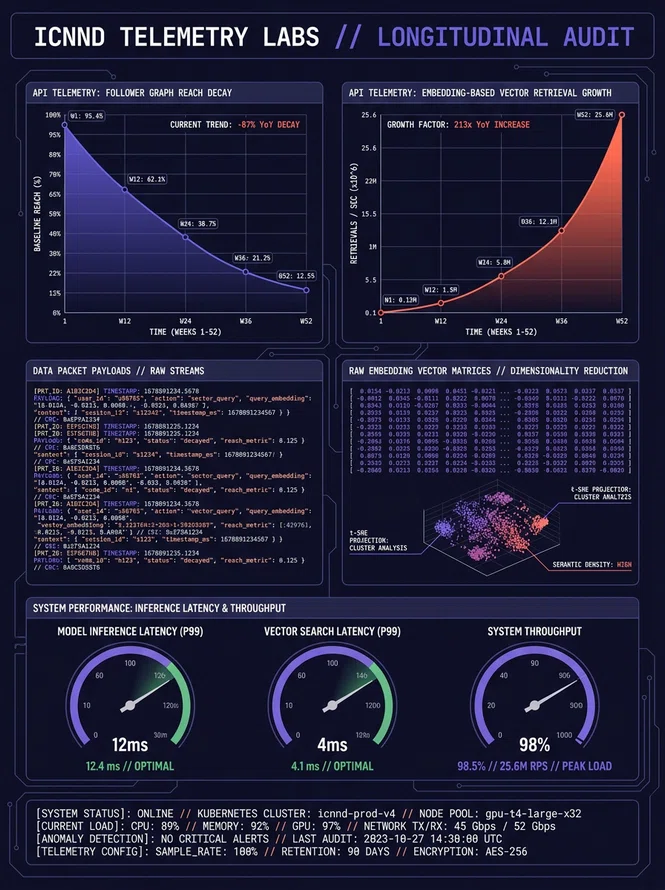
During the structural transformation between 2019 and 2022, static scoring gave way to high-dimensional representation learning. Our agency conducted comprehensive longitudinal audits across hundreds of enterprise accounts to trace how payloads were classified and served by Meta’s backend systems.
Empirical Platform Audits (Author Experience)
By capturing continuous response payloads through the Instagram Graph API and correlating telemetry metrics across client portfolios, we identified a profound architectural transition: the complete replacement of static affinity coefficients with real-time vector embeddings. Content distribution ceased to scale predictably based on follower velocity. Instead, distribution began mirroring mathematical clustering protocols.
Observation of Session Reset Vectors
Through our empirical testing, we isolated a phenomenon we documented as the Session Reset Vector. When an active user exited the Instagram client and reopened the app within a three-minute operational window, their first-pass candidate feed was not statically preserved. The candidate pool was recalculated on edge servers, adjusting the primary ranking order based on the micro-dwell times and profile visits recorded in the terminal 90 seconds of the prior session.
Correlating Latent Topic Modeling with Distribution
Our audits revealed that manually defined hashtags and caption keywords were rapidly losing ranking significance. Meta’s multimodal models began scanning raw video frames and audio spectrograms, translating content into latent conceptual representations. We found that optimizing your delivery schedule remains important, as covered in our analysis of the best time to post on Instagram globally, but temporal timing now functions purely as an initial query anchor for real-time embedding matching.
Deep Learning and Two Tower Retrieval Architectures
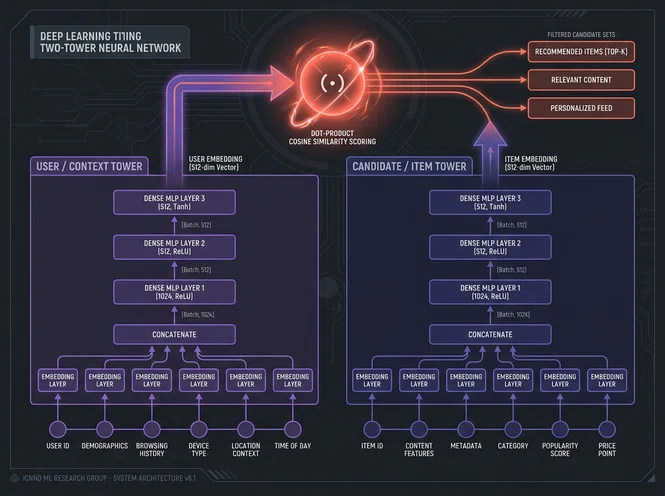
The contemporary feed infrastructure deployed across Instagram relies fundamentally on Two-Tower Neural Network architectures, a methodology deeply documented in Meta AI Research publications. The recommendation task is split across two concurrent deep neural networks: the User Query Tower and the Item Candidate Tower.
Candidate Generation and Retrieval
Every second, hundreds of millions of media items compete for display. To deliver responses in under 50 milliseconds, the candidate sourcing stage uses Approximate Nearest Neighbor (ANN) indexing over dense 512-dimensional vector spaces (utilizing algorithms like Hierarchical Navigable Small World graphs). The system collapses billions of candidate assets into a localized pool of ~500 items that share mathematical proximity with the user's current query embedding.
The Heavy Scoring Pipeline
Once the ~500 candidates are sourced, they enter the Heavy Scoring stage. Here, a large-scale Multi-Task Neural Network evaluates the candidate set against explicit probabilistic outcomes. The model does not generate a single vanity score; it outputs an array of discrete probability vectors:
The weights (w) are dynamically adjusted per user. If a user historically demonstrates a propensity for saving technical carousels but rarely leaves comments, the neural network adjusts the composite weights for that individual's scoring session accordingly.
Cold-Start Mechanics and Contextual Exploration
A persistent challenge in recommendation systems is the "cold-start" problem: how to accurately evaluate an asset with zero engagement history. Meta resolves this through Multi-Armed Bandit contextual exploration. Unranked assets are assigned a baseline exploration budget and injected into the feeds of a tightly clustered "seed audience" exhibiting high latent affinity for the asset's visual vectors. The model monitors the seed cohort's micro-signals to refine the asset's item embedding before triggering wider candidate retrieval.
Pro Tip: Candidate generation filters drop content before heavy ranking ever occurs. If your video exhibits weak visual clarity or discordant background audio, it fails the ANN vector distance calculation and is discarded during Phase 1 sourcing—regardless of account size.
The Fallacy of Shadowbans and Distribution Penalties
Within the creator and social media management community, unexplained reach contractions are almost universally attributed to the mythical "shadowban." From an engineering perspective, this diagnosis misinterprets automated integrity classifiers and distributed caching mechanics.
Platform-Level Reality vs. User Perception
Meta does not maintain a binary "shadowban switch" in its production databases. What creators perceive as a punitive blacklist is actually a deterministic outcome of the Recommendation Guidelines Safety Filter operating at Phase 4 of the ranking funnel. Content flagged for borderline themes, aggressive engagement loops, or low-trust provenance is filtered out of unconnected candidate generation while remaining accessible on the direct profile grid.
Integrity Classifier Cascades
Meta employs automated integrity models based on semi-supervised classification cascades. These models analyze content at ingestion time for signals such as clickbait syntactic patterns, misleading visual crops, and coordinated engagement behaviors. Flagged content is assigned an internal safety discount multiplier:
Cache Invalidation and Cold Infrastructure Drops
Sudden distribution collapses can also occur through infrastructure operations. During edge cluster load shedding, database partition migrations, or re-indexing of ANN cluster centroids, temporary indexing latencies occur. An account's freshly uploaded media asset may fail to propagate to regional edge caches during peak load, causing reach to crater without any policy violation having occurred.
The Shift from Social Graphs to Interest Graphs in Content Delivery
The most profound paradigm shift in social media history occurred between 2020 and 2026: the fundamental decoupling of content distribution from identity and social connections. Academic literature on network topology, including publications in the ACM Digital Library, describes this as the migration from topological diffusion to semantic discovery.
Decoupling Content from Identity
In the legacy social graph model, reach was constrained by audience size. A creator with one million followers possessed an insurmountable moat. In the contemporary Interest Graph paradigm, an asset's potential reach is bounded only by the size of the latent interest cluster matching its vector representation. The algorithm treats the creator identity merely as one of many contextual features (author authority, historical topic velocity) rather than an exclusive gatekeeper of distribution.
The Economics of Unconnected Distribution
Meta transitioned to this unconnected framework for clear economic reasons. Closed social graphs inevitably experience decay: users stop logging in, relationships go cold, and inventory stagnates. By introducing open-corpus retrieval across the primary feed (Suggested Posts, Reels), Meta unlocked infinite inventory liquidity. The system matches any piece of public content with any user whose behavioral vectors signal a high probability of satisfaction.
For brands and enterprise creators seeking to establish early authority in this interest-driven ecosystem, generating genuine conversation and validated social signals is paramount. Utilizing growth solutions from specialized partners like ICNND can establish the baseline engagement telemetry necessary for machine learning models to identify positive interaction patterns.
Multimodal Embedding Search
Under this interest architecture, Instagram processes raw media files through unified vision-language foundation models. The system analyzes visual objects, background environments, vocal frequencies, rhythmic cadences, and transcribed typography simultaneously, compiling them into a singular coordinate in a shared latent space.
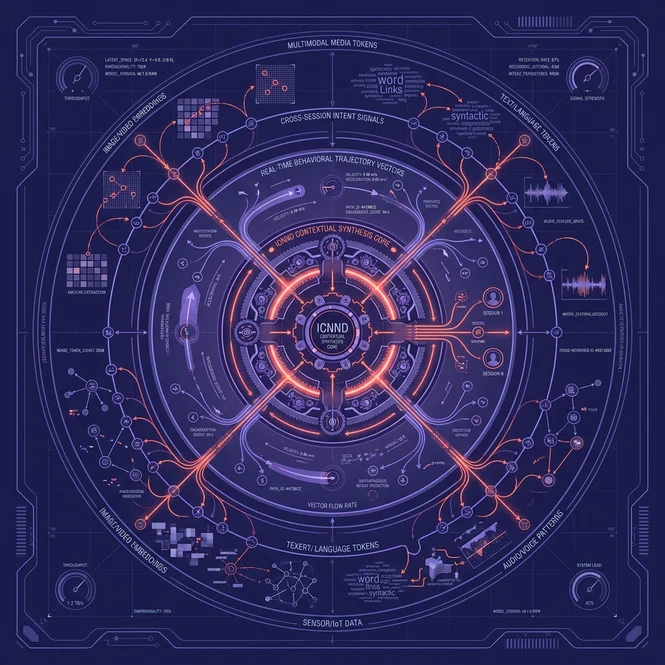
Predictive Intent Modeling and Contextual Synthesis in Contemporary Feeds
As we navigate 2026, the feed is shifting from a reactive recommendation system (evaluating past behavior) to a predictive intent engine (forecasting immediate psychological states and future utility).
Reinforcement Learning and Dwell-Time Precision
Modern ranking utilizes Contextual Bandit algorithms and Deep Reinforcement Learning from Human Feedback (RLHF). Rather than optimizing strictly for an immediate click or like, the neural network optimizes for Multi-Session Lifetime Value (LTV). The system measures post-consumption session continuation: did consuming this Reel cause the user to stay on the app for another 12 minutes, or did it trigger platform abandonment? Media assets that induce platform fatigue receive severe downstream scoring penalties.
Predictive Intent Analysis
Using transformer architectures adapted for sequential recommendation (such as SASRec and its modern successors, detailed in research from the OpenReview ML archive), Instagram models the exact sequence of past actions as a continuous sentence of user intent. The sequence [Watch 3s → Scroll → Double Tap → Watch 30s → Profile Tap] is processed through multi-head self-attention mechanisms to predict the exact category of media the user desires at this specific millisecond.
The Horizon of Generative Synthesis
The technical frontier points toward contextual feed assembly. Rather than merely selecting a pre-rendered MP4 video from a static database, Meta's next-generation edge pipelines are piloting dynamic asset assembly: altering captions, thumbnail frames, and sound mastering in real time to match the specific latent preferences of individual viewer cohorts.
Strategic Imperatives for Engineering Organic Reach in Neural Networks
The sixteen-year evolution from chronological sorting to machine learning invalidates legacy marketing tactics. Growth can no longer be brute-forced through upload volume or engagement pods. Winning in the modern interest graph demands rigorous semantic engineering.
Semantic Consistency over Volume Arbitrage
Because the Item Tower constructs an account-level semantic centroid, pivoting erratically across divergent content themes creates severe vector dispersion. When an account publishes disparate topics, its item embeddings become noisy, reducing candidate retrieval confidence during Phase 1 sourcing. Precision creators must maintain strict thematic coherence to anchor their account firmly within high-value vector clusters.
Optimizing for High-Value Downstream Signals
Modern scoring architectures heavily prioritize meaningful interactions. Align your creative engineering around non-binary actions:
Framework for Academic and Strategic Application
The sixteen-year evolution of the feed can be summarized as a systematic migration from time-centric storage to relationship-centric heuristics, and ultimately to vector-centric cognition. By treating Instagram not as a social network, but as a real-time semantic discovery engine, growth practitioners and researchers can structure reliable models of organic distribution that remain resilient against ongoing architectural evolutions.
💡 Frequently Asked Questions
Authoritative answers on the historical and modern mechanics of the Instagram feed algorithm.
Why did Instagram abandon the chronological feed in 2016? +
How does the Two-Tower neural network rank posts? +
What is the difference between a Social Graph and an Interest Graph? +
Are shadowbans real from an engineering perspective? +

Written by Elena
View Full Profile →Senior Social Media Strategist & Algorithm Analyst
Elena has spent over a decade reverse-engineering Meta's backend discovery architectures and recommendation systems. Her longitudinal analyses and mathematical frameworks bridge the gap between machine learning engineering and actionable growth strategy for global enterprise brands.